How to Understand Pharmaceutical Testing Processes and Guidelines?
Understanding the complexities of Pharmaceutical Testing is crucial for ensuring the safety and efficacy of new drugs. The pharmaceutical industry is rapidly evolving, with a significant increase in the number of new therapies entering clinical trials. According to a report by the IQVIA Institute, the global R&D spend reached $186 billion in 2022, emphasizing the importance of rigorous testing standards.
Dr. Emily Walsh, a leading expert in pharmaceutical testing, states, “Proper testing protocols are the backbone of successful drug development.” This highlights the need for pharmaceutical companies to adhere to established guidelines. Various phases of testing, from preclinical to post-market, require precise methodologies and thorough documentation. Yet, many companies still face challenges in navigating regulatory frameworks.
Imperfect testing processes can lead to major setbacks in drug approval. Recent data indicates that around 60% of drugs fail to reach the market due to inadequate testing. Such statistics prompt a necessary reflection on how the industry can improve its practices. With ongoing changes in regulations and emerging technologies, the landscape of Pharmaceutical Testing continues to grow more complex. Understanding these processes is essential for stakeholders, and ongoing education in this area is vital.

Overview of Pharmaceutical Testing Processes
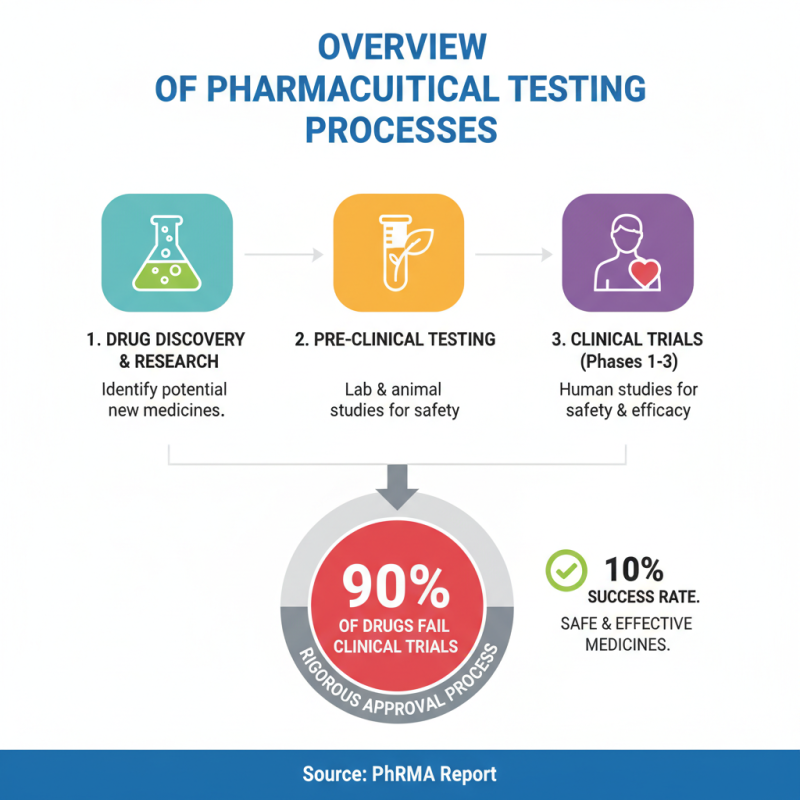
Pharmaceutical testing processes are critical in drug development. These processes ensure that new medications are safe and effective for public use. According to a report by the Pharmaceutical Research and Manufacturers of America (PhRMA), about 90% of drugs that enter clinical trials do not receive approval. This highlights the rigorous nature of these testing phases.
During these tests, numerous guidelines dictate the protocols. Preclinical studies involve lab tests and animal studies to gauge safety. Then, clinical trials progress through three main phases. Phase 1 focuses on safety in a small group. Phase 2 tests efficacy in a larger group. Phase 3 compares the new drug against existing treatments. Despite strict adherence to these guidelines, inconsistencies can arise, leading to setbacks in drug approval.
Errors in trial design, inadequate participant selection, and even data management issues can impede progress. For instance, in 2020, the FDA cited approximately 15% of clinical trials for non-compliance with good clinical practice. The landscape of pharmaceutical testing is ever-evolving, pushing for more transparency and improved methodologies. As challenges arise, the industry must adapt to ensure reliable results.
Key Regulations Governing Pharmaceutical Testing
Pharmaceutical testing is crucial for ensuring drug safety and efficacy. Significant regulations govern these processes. The U.S. FDA (Food and Drug Administration) sets strict standards. They require extensive clinical trials before drugs reach the market. These guidelines are designed to protect public health.
GMP (Good Manufacturing Practices) ensure consistency during production. This involves maintaining clean environments and proper documentation. Failing to comply can lead to recalls or bans. It’s vital for companies to understand these regulations deeply.
Tips: Always stay updated with changing regulations. Regular training for staff can minimize mistakes. Don't overlook the importance of documentation. Accurate records can make or break an approval process. Testing is often a time-consuming journey. Embrace the challenges and learn from the imperfections along the way.
Stages of Drug Development and Testing
The drug development process is long and complex. It consists of multiple stages. Each stage is crucial for ensuring safety and efficacy.
The first stage is preclinical testing. This involves laboratory studies and animal testing. According to the FDA, around 70% of drugs that enter clinical testing fail. That's a significant number. It highlights the uncertainty in drug development. Next, clinical trials begin. They are divided into three phases. Phase 1 tests safety with a small group. Phase 2 focuses on efficacy and dosing. It typically includes hundreds of patients. Phase 3 expands this to thousands, confirming effectiveness and monitoring adverse reactions. A study by the Tufts Center for the Study of Drug Development found that this process, from preclinical to approval, takes an average of 10 to 15 years.
Post-approval, the drug enters Phase 4, or post-marketing surveillance. Doctors and patients report any adverse effects. This phase is vital for long-term safety. The reality is that not all data from these trials is perfect. Some side effects may not emerge until years later. This uncertainty poses challenges for regulatory bodies. The need for continuous monitoring remains critical, even after a drug is on the market.
Stages of Drug Development and Testing
Methods and Techniques Used in Pharmaceutical Testing
Pharmaceutical testing is critical in the drug development process. Various methods are employed to ensure safety and efficacy. One common technique is in vitro testing. This involves studying drug effects on cells or tissues outside a living organism. It allows researchers to observe interactions in a controlled environment.
Another key method is animal testing. While controversial, it provides insights that cannot be obtained in vitro. Researchers aim to simulate human responses. However, this method can be unreliable and raises ethical concerns. Balancing scientific progress with ethical considerations is challenging but necessary.
Lastly, clinical trials are conducted to evaluate drugs in human subjects. These trials follow strict protocols and guidelines. They are divided into phases to assess different aspects of drug performance. Yet, limitations exist. Variability in human responses can affect results. Continuous review and adaptation of methods are essential for improvement.
How to Understand Pharmaceutical Testing Processes and Guidelines?
| Testing Phase |
Objective |
Common Techniques |
Regulatory Guidelines |
| Preclinical Testing |
Assess safety and biological activity |
In vitro studies, animal models |
FDA Guidance for Industry |
| Phase I Clinical Trials |
Evaluate safety, dosage, and side effects |
Single ascending dose, multiple dosing |
ICH E6 Guidelines |
| Phase II Clinical Trials |
Assess effectiveness and further evaluate safety |
Randomized controlled trials |
FDA Guidance |
| Phase III Clinical Trials |
Confirm effectiveness, monitor side effects |
Large-scale trials, multicenter studies |
ICH E8 Guidelines |
| Post-Marketing Surveillance |
Monitor long-term effects and performance |
Registry studies, observational studies |
FDA REMS Guidelines |
Importance of Clinical Trials in Drug Approval
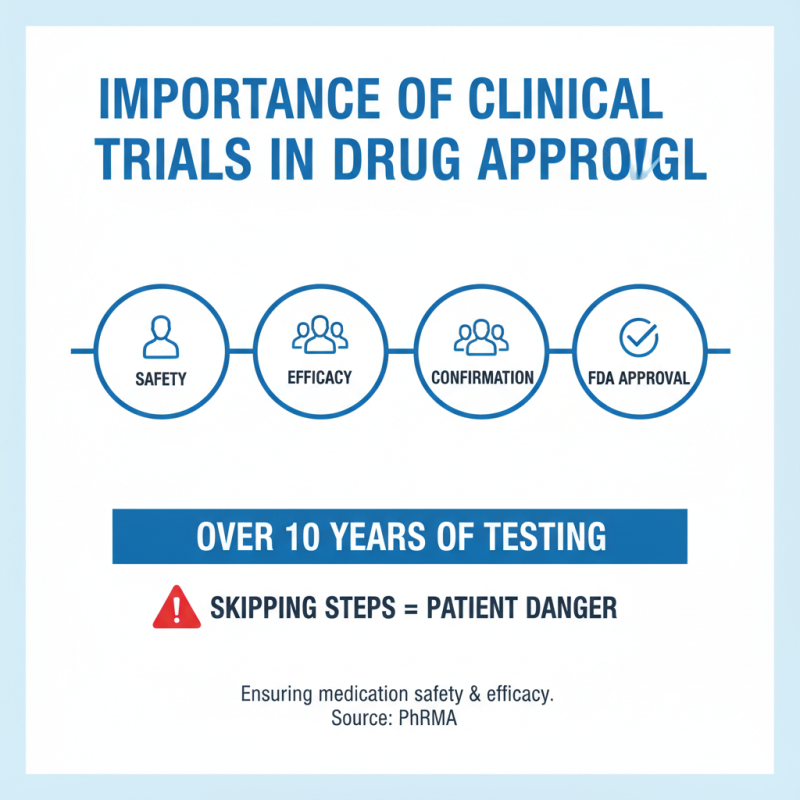
Clinical trials play a pivotal role in the drug approval process. These trials assess the safety and efficacy of new medications before they reach the market. According to the Pharmaceutical Research and Manufacturers of America, it can take over ten years for a drug to complete all testing phases. This timeline is critical; skipping any step could endanger patients.
In 2021, the FDA reported approving 50 novel drugs. Many of these came from extensive clinical trial phases, which involved tens of thousands of participants. However, not every trial succeeds. Some fail due to insufficient efficacy or unforeseen side effects. The industry sees a staggering 90% failure rate for drugs in development. This reality raises questions about the reliability of the trials.
Moreover, there’s variability in trial design and execution. Some studies lack diversity in participant demographics. This can lead to results that do not accurately represent the entire population. As a result, questions about generalizability arise. More efforts are essential to ensure trials are inclusive and reflect real-world situations. The reliance on these processes means constant improvement should be a priority for research institutions and pharmaceutical companies alike.