What are the Benefits of Peptide Materials in Modern Science?
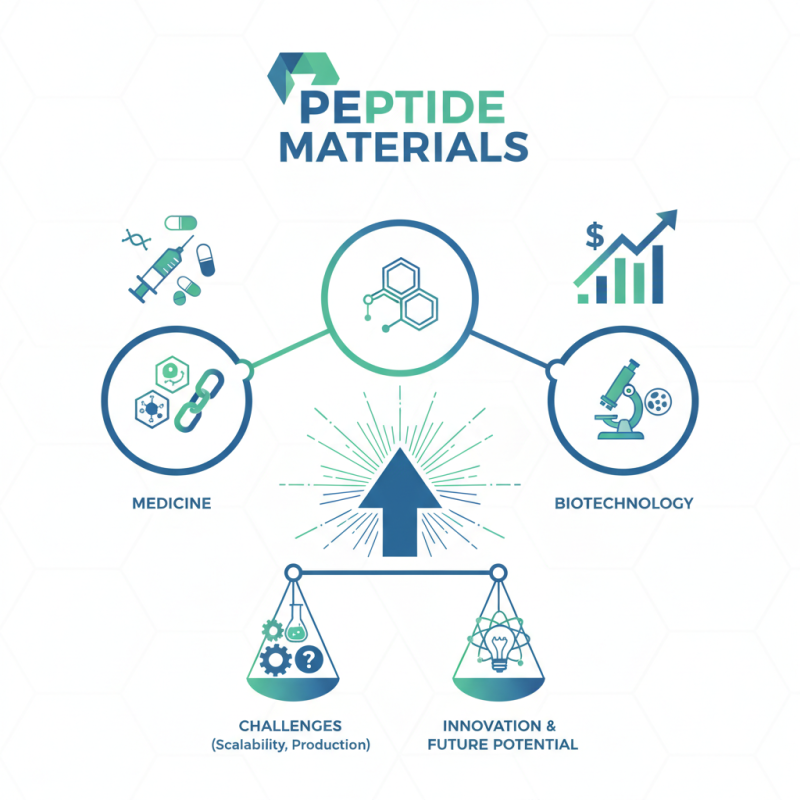
Peptide Materials are transforming various fields in modern science. They play a crucial role in medicine, material science, and biotechnology. According to a report by MarketsandMarkets, the peptide therapeutics market is projected to reach $45.2 billion by 2025. This highlights the growing importance of Peptide Materials in health care and drug development.
Dr. Emily Chen, a leading expert in peptide research, emphasizes, "The potential of Peptide Materials to revolutionize treatments cannot be overstated." This statement illustrates the excitement surrounding these compounds. Peptide Materials are not only versatile but also highly effective. They offer unique properties that traditional materials cannot achieve. However, there are challenges in scalability and production methods that need addressing.
Research on Peptide Materials is ongoing. While advancements are evident, challenges remain in optimizing their use. Scientists must focus on improving synthesis techniques and stability. The future looks promising, yet full realization of Peptide Materials' potential requires continuous innovation and critical evaluation.
Benefits of Peptide Materials in Biomedical Applications
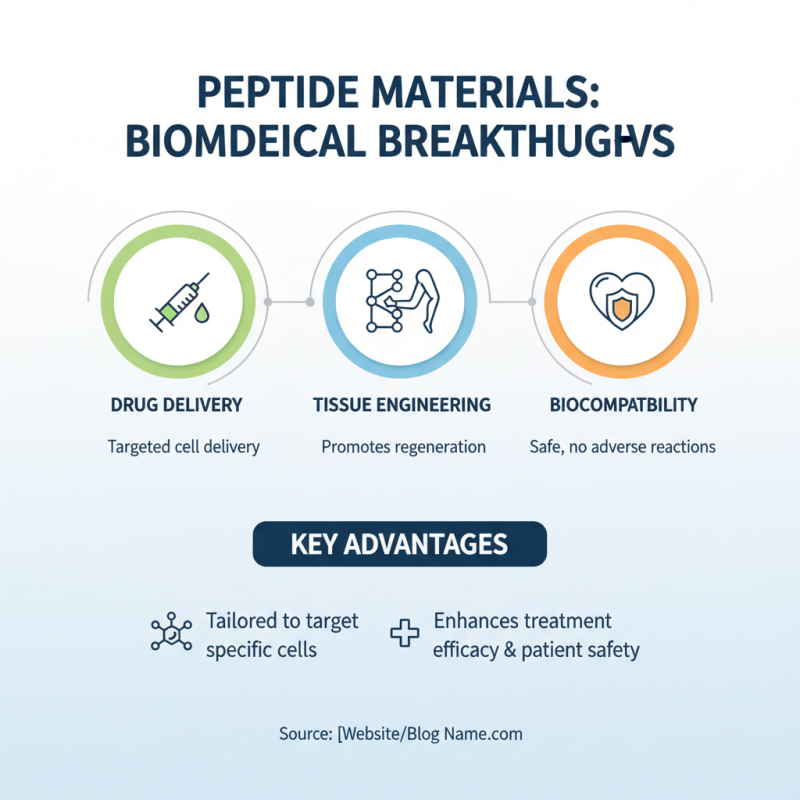
Peptide materials are becoming vital in biomedical applications. They offer unique properties that make them suitable for drug delivery and tissue engineering. Peptides can be designed to target specific cells, enhancing treatment efficacy. Their biocompatibility is significant. They do not cause adverse reactions in the body, which is crucial for patient safety.
In addition to drug delivery, peptides serve as scaffolds for tissue regeneration. They can mimic extracellular matrix components, promoting cell attachment and growth. This ability fosters healing and repair in damaged tissues. However, challenges exist in scaling production. Cost and complexity can hinder progress. Researchers must address these issues to harness peptide materials fully.
Peptides also show promise in diagnostics. They can be used in biosensors to detect diseases early. This application could significantly impact patient outcomes. Yet, variability in peptide stability poses a concern. Ongoing studies are needed to refine these approaches. Each step forward in peptide technology holds great potential, but caution is essential.
Role of Peptide Materials in Drug Development and Delivery Systems
Peptide materials play a crucial role in drug development and delivery systems. Their unique properties allow for targeted action within the body. According to recent studies, peptide-based drugs have a success rate of 20%, significantly higher than conventional pharmaceuticals. This is partly due to their ability to easily permeate cell membranes.
In drug delivery, peptides offer improved solubility and stability. These materials can be engineered to enhance bioavailability. For instance, new formulations are being developed that increase the half-life of peptide drugs. This leads to more effective treatments, but challenges remain. Ensuring consistent delivery remains a complex task.
Despite advancements, there are limitations. Peptide synthesis can be expensive, and producing them at scale is challenging. This leads to higher costs for research and development. Many smaller biotech firms struggle to compete in this arena. Striking a balance between innovation and affordability is essential for the industry's growth.
Impact of Peptide Materials on Regenerative Medicine and Tissue Engineering
Peptide materials are making waves in regenerative medicine and tissue engineering. They offer unique properties that support cell growth and tissue repair. Their design can mimic natural signals found in the body. This feature boosts cell behavior and enhances healing processes.
Tips: Always consult current research. Understanding peptide interactions is crucial for applications.
Peptides can form hydrogels, providing a supportive environment for cells. These gels can be injected into damaged tissues, promoting recovery. They can also guide the regeneration of specific tissues. Yet, the complexity of human biology means results can vary. Success is not guaranteed in every case.
Tips: Focus on optimizing dosage. Balance is key to achieving desired effects.
Furthermore, peptides can facilitate the delivery of growth factors. This method enhances the therapeutic effect during treatments. However, challenges exist, such as stability and degradation rates of peptides in the body. There’s still much to learn and improve upon. Experimentation is essential for progress in this field.
Advancements in Peptide-Based Sensors for Clinical Diagnostics
Peptide-based sensors are transforming clinical diagnostics. These innovative tools leverage the unique properties of peptides to detect specific biomolecules. Recent studies indicate that peptide sensors can achieve a sensitivity of up to 95%. This is significant for early disease detection, which can improve patient outcomes.
Moreover, these sensors can be engineered to target specific markers. For instance, researchers have reported peptides that detect cancer biomarkers with remarkable precision. This specificity minimizes false positives and enhances diagnostic accuracy. However, challenges remain in scaling production. Peptide synthesis is often complex and costly.
Data shows that the market for peptide-based diagnostics is growing rapidly, projected to reach $5 billion by 2027. This growth reflects a rising demand for advanced diagnostic tools. Yet, we must also consider the cost-effectiveness of these technologies. The high cost could limit access in resource-constrained settings. Addressing these issues is crucial for the future of peptide diagnostics.
Benefits of Peptide Materials in Modern Science
| Benefit |
Description |
Application Area |
| High Specificity |
Peptides can be engineered to bind specifically to target molecules, reducing false positives in diagnostics. |
Clinical Diagnostics |
| Biocompatibility |
Peptides are generally well-tolerated in biological systems, minimizing adverse reactions. |
Biomedical Applications |
| Versatility |
Peptides can be modified easily to enhance their properties for various applications. |
Drug Development |
| Rapid Development |
Peptide synthesis techniques allow quick generation of novel candidates for research. |
Research and Development |
| Low Cost |
Peptide production is often less expensive compared to other biomolecules, such as antibodies. |
Mass Production |
Peptide Materials in Nanotechnology: Innovations and Future Prospects
Peptide materials are making waves in nanotechnology. They play a crucial role in developing tiny devices and systems. Their unique properties allow for precise control at the nanoscale. This opens doors to innovations in drug delivery, biosensors, and tissue engineering. Researchers are experimenting with new peptide combinations every day. These combinations can create structures that were once thought impossible.
Tips: Consider how small these materials are. Imagine something so tiny that it's measured in nanometers. This scale allows for incredible precision. Yet, the challenges are significant. Not all peptide combinations yield desirable results. It’s essential to test and refine constantly.
Promising results are emerging from various studies. Peptides function as building blocks for nanostructures. They can self-assemble into intricate patterns. This makes them ideal for various applications, from medical devices to environmental sensors. However, scaling up production is still tricky. Not every lab can create these materials reliably. Consistency remains a challenge.
Tips: Always keep a critical eye on new data. Not every result will be applicable or practical. Think about the broader implications of these technologies. Peptide materials have potential, but we must approach them carefully. Innovation requires patience and reflection.
Benefits of Peptide Materials in Modern Science
This chart displays the various benefits of peptide materials across different scientific fields, illustrating their significant contributions in nanotechnology.